No Sign of an AI Bubble as Tech Giants Double Down at World’s Largest Technology Show
Executives and investors at CES showcase accelerating investment and real-world applications, brushing aside fears of an artificial intelligence slowdown
Artificial intelligence optimism dominated the world’s largest technology exhibition this week, with little evidence on the show floor that concerns over an AI investment bubble are dampening industry momentum.
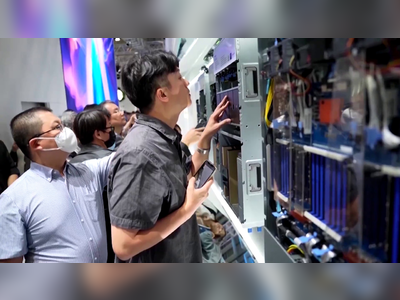
At the annual Consumer Electronics Show in Las Vegas, companies unveiled a wide range of AI-powered products and systems, from humanoid robots designed for industrial work to consumer appliances and next-generation computing platforms, underscoring confidence that AI adoption is still in its early stages.
Executives from major technology groups emphasised that their focus remains on building practical products and infrastructure rather than reacting to short-term market anxieties.
Leaders from companies including Amazon, Intel, Qualcomm and Samsung expressed the view that AI represents a long-term technological shift rather than a passing trend, pointing to growing demand across manufacturing, healthcare, logistics and consumer electronics.
Investment figures reflect that conviction, with tens of billions of dollars flowing into data centres and AI infrastructure in the past year alone and capital spending expected to rise further as companies race to secure computing capacity.
While some analysts have warned that spending may be running ahead of immediate demand, executives at the event argued that progress in areas such as on-device processing, energy efficiency and specialised chips is broadening AI’s reach beyond power-hungry cloud systems.
Nvidia, whose hardware sits at the centre of the AI build-out, used the show to outline updates to its data-centre computing platform scheduled for release later this year, reinforcing its role as a key supplier to the sector.
Meanwhile, chipmakers highlighted efforts to process AI tasks locally on laptops, smartphones and embedded systems, reducing dependence on centralised infrastructure.
Beyond computing hardware, exhibitors also pointed to emerging consumer and industrial use cases, including robots capable of complex physical tasks and new wearable devices that rely on AI to organise and interpret daily activity.
While a minority of industry voices acknowledged that parts of the market may be overheated, there was broad agreement that artificial intelligence has already become embedded in everyday technology and business operations.
The atmosphere at the exhibition suggested that, regardless of debate over valuation and investment cycles, companies are pressing ahead with AI development as a foundational pillar of future growth.
At the annual Consumer Electronics Show in Las Vegas, companies unveiled a wide range of AI-powered products and systems, from humanoid robots designed for industrial work to consumer appliances and next-generation computing platforms, underscoring confidence that AI adoption is still in its early stages.
Executives from major technology groups emphasised that their focus remains on building practical products and infrastructure rather than reacting to short-term market anxieties.
Leaders from companies including Amazon, Intel, Qualcomm and Samsung expressed the view that AI represents a long-term technological shift rather than a passing trend, pointing to growing demand across manufacturing, healthcare, logistics and consumer electronics.
Investment figures reflect that conviction, with tens of billions of dollars flowing into data centres and AI infrastructure in the past year alone and capital spending expected to rise further as companies race to secure computing capacity.
While some analysts have warned that spending may be running ahead of immediate demand, executives at the event argued that progress in areas such as on-device processing, energy efficiency and specialised chips is broadening AI’s reach beyond power-hungry cloud systems.
Nvidia, whose hardware sits at the centre of the AI build-out, used the show to outline updates to its data-centre computing platform scheduled for release later this year, reinforcing its role as a key supplier to the sector.
Meanwhile, chipmakers highlighted efforts to process AI tasks locally on laptops, smartphones and embedded systems, reducing dependence on centralised infrastructure.
Beyond computing hardware, exhibitors also pointed to emerging consumer and industrial use cases, including robots capable of complex physical tasks and new wearable devices that rely on AI to organise and interpret daily activity.
While a minority of industry voices acknowledged that parts of the market may be overheated, there was broad agreement that artificial intelligence has already become embedded in everyday technology and business operations.
The atmosphere at the exhibition suggested that, regardless of debate over valuation and investment cycles, companies are pressing ahead with AI development as a foundational pillar of future growth.