
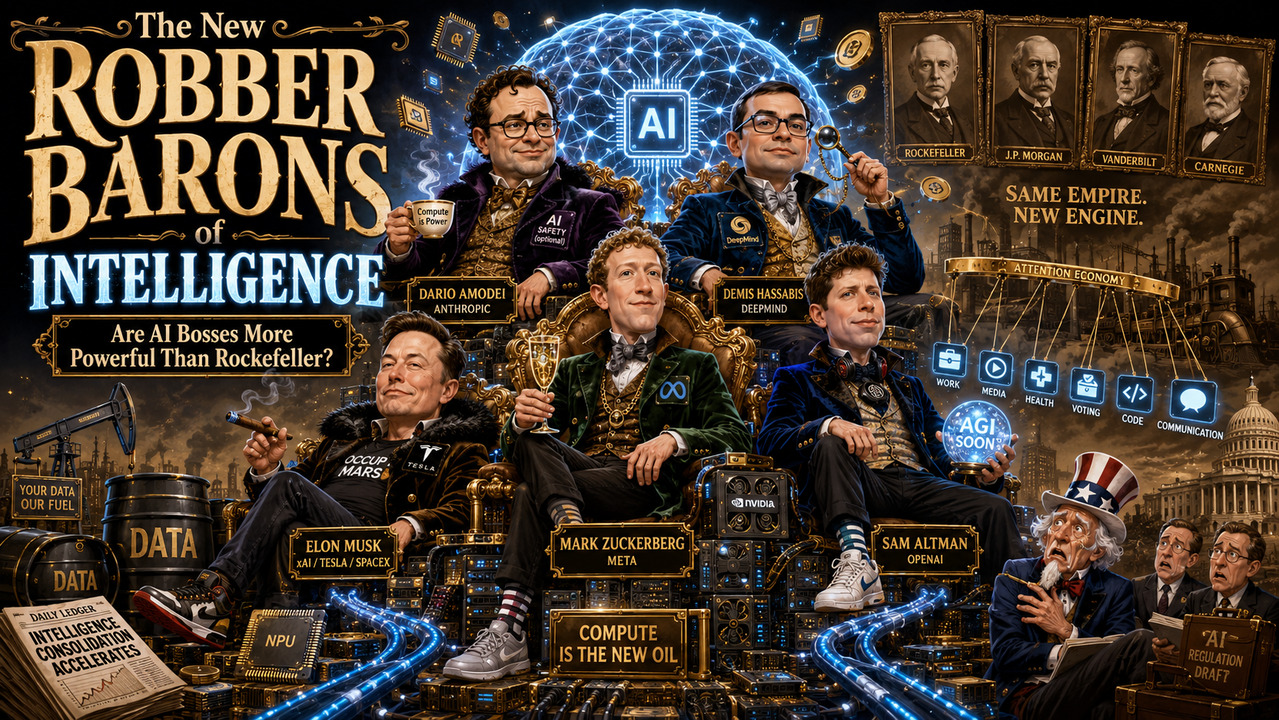
The New Robber Barons of Intelligence: Are AI Bosses More Powerful Than Rockefeller?
They are not presidents. They do not command armies. They do not pass laws. Yet they are building systems that may soon influence how people work, learn, code, search, fight, heal, vote, and think. Their power is not just financial. It is infrastructural. They sit near the control panels of a technology that could become the nervous system of the 21st century.
That is why governments are beginning to look nervous.
OpenAI says ChatGPT now has hundreds of millions of weekly users, a scale that turns a private product into something closer to public infrastructure. Anthropic’s newest frontier systems have already raised concerns inside cybersecurity circles because of their growing autonomous capabilities. Governments and researchers are increasingly testing these models not just for convenience, but for their potential impact on national security, cyber warfare, information control, and economic power.
This is no longer only a story about clever chatbots. It is a story about private companies building tools that can write software, discover vulnerabilities, automate research, shape information flows, and potentially accelerate military and economic competition. AI is becoming a new layer of power.
And America has seen this movie before.
The First Age of Private Titans
In the late 19th century, during the Gilded Age, America was transformed by railroads, oil, steel, electricity, finance, and mass manufacturing. The country became richer, faster, more connected, and more industrial than ever before. But that transformation was not led by democratic committees. It was driven by a small group of ruthless private builders.
John D. Rockefeller built Standard Oil. Andrew Carnegie built Carnegie Steel. Cornelius Vanderbilt helped shape the modern railroad empire. J.P. Morgan dominated finance. They were not merely businessmen. They were system-builders. They controlled the arteries through which the economy moved.
Rockefeller’s Standard Oil refined nearly all of America’s oil by the 1880s, and Rockefeller’s personal fortune eventually reached levels almost unimaginable even by modern standards. J.P. Morgan’s influence became so enormous that during the financial panic of 1907, the U.S. government and banking sector depended heavily on his intervention to stabilize the collapsing financial system.
That is what made the robber barons so frightening. They did not simply get rich. They became necessary.
Rockefeller did not own oil in the abstract. He controlled refining, transport, pricing, distribution, and the competitive terms under which others could survive. Morgan did not merely invest in companies. He could rescue—or strangle—the financial system. Railroads did not merely move passengers. They decided which towns would grow and which would die.
Their genius was real. Their contribution was real. But so was the danger. When private empires become too essential, the public starts asking a brutal question:
Who really governs the country?
The AI Barons Are Different—and Maybe More Dangerous
Today’s AI chiefs are not perfect copies of Rockefeller or Morgan. Their companies compete fiercely. Their products are still evolving. Their empires are not all monopolies in the old industrial sense.
But the power they are accumulating may be deeper.
Rockefeller controlled oil, a physical commodity. The AI bosses are competing to control intelligence infrastructure: the models, data centers, developer platforms, consumer assistants, enterprise agents, and research systems that could sit underneath every industry.
Oil moved machines. AI may move decisions.
Steel built cities. AI may build software.
Railroads moved people and goods. AI may move knowledge, labor, influence, and military advantage.
This is why the comparison to Rockefeller is not exaggerated. It may actually be too small.
The AI race is not only about who makes the best chatbot. It is about who owns the operating layer between humans and information. If a billion people ask one company’s system what to read, what to buy, what to believe, how to write, how to code, how to diagnose, how to negotiate, or how to vote, that company becomes more than a business. It becomes a gatekeeper of reality.
Demis Hassabis represents the scientific side of that power, where AI is already accelerating discoveries in biology and chemistry. Sam Altman represents mass adoption and the rapid integration of AI into daily life. Dario Amodei represents the paradox of AI safety: the companies warning about existential risks are often the same companies racing to build even more powerful systems. Mark Zuckerberg represents planetary-scale distribution through Meta’s social ecosystem. Elon Musk represents the fusion of AI with transportation, satellites, robotics, media influence, and geopolitical power.
Rockefeller had pipelines. These men have platforms.
Morgan had banks. These men have models.
Vanderbilt had railroads. These men have compute.
The old barons controlled the physical economy. The new barons are competing to control the cognitive economy.
The Government’s Dilemma
The U.S. government faces a problem it has faced before: it wants the innovation, but fears the concentration.
Washington understands that AI is not just another tech trend. It may determine military superiority, economic dominance, cyber defense, scientific leadership, and geopolitical influence for decades to come. That is why many policymakers hesitate to regulate too aggressively. They fear slowing America down while China accelerates.
The logic is simple: if AI is the next industrial revolution, then America’s frontier AI labs are not just corporations. They are strategic assets.
But the emotional temperature is changing.
When AI systems begin demonstrating advanced cyber capabilities, governments start imagining worst-case scenarios: automated hacking, large-scale misinformation, infrastructure sabotage, autonomous surveillance, economic disruption, and concentration of informational power in the hands of a few private firms.
This is exactly how backlash begins. Not with philosophy. With fear.
The Old Answer Was Antitrust and Institutions
America eventually answered the robber barons by reasserting public authority.
In 1911, the Supreme Court ordered the breakup of Standard Oil after ruling that the company violated antitrust laws. The message was historic: no private corporation could dominate a critical industry forever without limits.
Then, after the Panic of 1907 exposed the danger of relying on one financier to stabilize the economy, Congress created the Federal Reserve in 1913. America decided that its financial system could not depend on the judgment of one billionaire banker.
That is the historical pattern.
First, private men build faster than the state can understand.
Then society becomes dependent on their systems.
Then their power becomes intolerable.
Finally, government catches up—with courts, regulations, agencies, and institutional control.
The question now is whether AI is approaching that same breaking point.
Are They More Powerful Than Rockefeller?
In pure monopoly terms, not yet.
Rockefeller’s grip on oil was more concentrated than any single AI company’s grip on intelligence today. AI remains a brutal competitive battlefield involving OpenAI, Anthropic, Google, Meta, xAI, Microsoft, Amazon, Nvidia, Apple, and others.
But in potential scope, the AI bosses may become far more powerful.
Rockefeller shaped how Americans lit their homes and fueled machines. AI could shape how humanity produces knowledge itself.
Rockefeller’s empire touched industry. AI touches every industry.
Standard Oil controlled a supply chain. AI may become the supply chain for cognition, creativity, research, automation, persuasion, and cyber power.
That is why the phrase “AI boss” is too small. These men are not just executives. They are unelected architects of a new operating system for civilization.
The brutal truth is this:
The danger is not necessarily that they are evil.
The danger is that they are human.
They have investors, egos, rivals, political relationships, commercial pressures, ideological biases, and survival instincts. Yet they are making decisions whose consequences may spill far beyond their companies.
The robber barons built America’s industrial body.
The AI barons are building its artificial brain.
And if history teaches anything, it is this:
When private power becomes public infrastructure, democracy eventually demands a seat at the table.
1-Minute Voiceover Script
Are today’s AI bosses more powerful than Rockefeller?
In the Gilded Age, men like John D. Rockefeller, Andrew Carnegie, Cornelius Vanderbilt, and J.P. Morgan built the systems that powered modern America: oil, steel, railroads, and finance. They created enormous progress, but they also gained terrifying levels of power. Rockefeller’s Standard Oil dominated the oil industry, and J.P. Morgan became so influential that the government relied on him to help stop a financial collapse in 1907.
Today, a new group of tech leaders—Dario, Demis, Elon, Mark, and Sam—are building something potentially even more powerful: artificial intelligence.
The old barons controlled physical infrastructure. The new AI barons may control cognitive infrastructure: information, decisions, software, research, communication, and even influence itself.
That is why governments are getting nervous. History shows that when private companies become too powerful and too essential, regulation eventually follows. America once broke up Standard Oil and created the Federal Reserve.
The question now is whether AI will face its own reckoning.