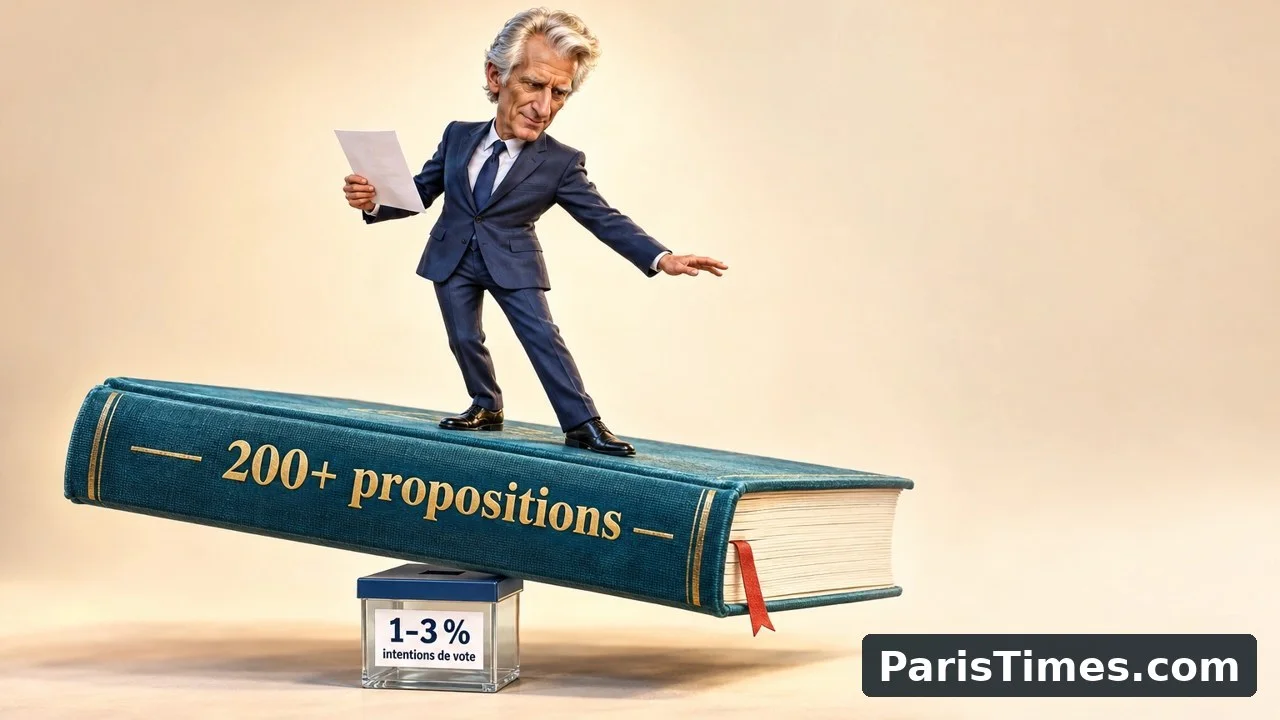
Dominique de Villepin is seeking the French presidency without choosing between left and right, proposing to make the head of state an arbiter rather than the director of daily government. The 73-year-old former prime minister under Jacques Chirac defended his cross-party candidacy for La France Humaniste on Monday, November 23, 2026: “I don’t want to fit into a box.”
He announced his candidacy on Friday, November 20. Appearing on the evening television news three days later, he challenged the strategy of mobilizing a political base in the first round before reaching outward in the runoff. How, he effectively asked, can candidates unite voters they have already ignored or alienated?
Winning “8, 10, 15, 20 percent” within a political camp says nothing about the ability to build a “democracy of consent,” which he considers essential to passing even the smallest reform. He called the reduction of the presidential contest to a competition between camps “the deception of this precampaign” and a “degeneration of the Fifth Republic.”
His proposed approach to the presidency follows from that diagnosis. The “general interest” must again become the president’s compass, he argued, after an uninterrupted succession of crises since 2007 that, in his view, has left France in a state of permanent emergency. “Let’s forget the hyper-president who is now a phantom president. Let’s bring back a president who acts as an arbiter.”
Asked what that arrangement would leave to the prime minister, Villepin said the president would work with the government. His emphasis was on restoring an authority capable of commanding a hearing across the country, citing labor disputes, students’ difficulties and the high cost of living. In the presidency he describes, strength would come from the ability to bring people together rather than daily intervention in government.
His attempt to cross partisan boundaries comes with an aggressive prediction: the political center, now consumed by internal competition, will “probably collapse” in the coming weeks and months, he said. Yet he resisted defining himself simply as that bloc’s fallback candidate. He wants to unite people around a new political method to “restore the state” and “repair the Republic.”
He described a financially and socially wounded France, divided along territorial, social and political lines. His proposed response drew on the language of repair: find “a needle, some stitches” and patiently reinvent a French model and a society “where we can still love one another.”
His comeback also draws on memories of the Chirac years. One man interviewed recalled admiring the bearing of Chirac’s former prime minister; another wanted someone capable of uniting people in the face of extremes on both left and right. Those comments accompany a campaign seeking to rebuild popularity and political support without a team of established political stars.
His staff is young, and many come from the left. Political adviser Sacha Mokritzky previously worked for Jean-Luc Mélenchon’s party and then for Arnaud Montebourg. Communications director Baptiste Fournier worked on the campaign of Cédric Villani, who had an environmentalist orientation. On social media, Villepin also cultivates eclectic tastes, ranging from theater to music, including Théodora.
Turning that positioning into a place on the ballot remains a practical challenge. On Friday, November 20, Villepin highlighted the backing of Laurent de Gaulle, a mayor and the general’s great-nephew. In 2012, he fell a few dozen endorsements short of being able to run.
This time, he says he is more confident. About 100 people are working on the endorsement drive across France. Having previously cited 300 mayors, he now estimates that he has “probably a few more,” while stressing that meetings and outreach continue every day.
To illustrate the difficulty, he said Marine Le Pen, whom he put at 35 percent in the polls, had not secured her signatures either. His interviewer countered that she was almost certain to obtain them. Villepin maintained that collecting endorsements was difficult and expressed confidence in his team’s work.
Money is the other test. La France Humaniste’s 80,000 members had previously paid no dues. Membership now costs €20, and fundraising dinners are said to have begun. Villepin said the movement is now financed entirely by membership dues and donations.
His rejection of political labels does not mean treating every party as equivalent. Asked about his refusal to put Jean-Luc Mélenchon and Marine Le Pen on the same footing, and then about a potential runoff between them that the question described as predicted by polls, he offered no voting instruction: “I don’t engage in political hypotheticals.”
He did spell out the distinction. In his view, the National Rally is a party whose “racist, xenophobic and antisemitic legacy cannot be put on an equal footing with other parties.” In his campaign, reaching beyond political camps does not mean erasing the differences between them.